
10 Common Welding System Questions Answered
Posted on: 22/06/2026 Read time: 6 minutes
In fabrication environments where accuracy, repeatability, and efficiency matter, the conversation is increasingly shifting from welding tables to welding systems. While basic tables have their place, modern workshops require modular solutions that support repeat builds, reduce rework, and scale with production demands.
As Australia’s sole distributor of Demmeler, Leussink works with manufacturers, fabricators, and engineers to implement welding solutions that deliver measurable improvements in productivity and quality.
Below, we answer 10 questions about welding related to modular tables and integrated fabrication setups, clearly, practically, and with decision-making in mind.
What Is a Welding System?
A welding system is a modular, precision-engineered platform designed to improve accuracy, repeatability, and production efficiency in fabrication operations.
This approach goes beyond a flat surface, providing an integrated solution where components can be positioned, clamped, and reproduced with high precision across multiple jobs.
What Is the Difference Between a Welding Table and a Welding System?
A welding table provides a single, flat work surface, while a welding system is a complete modular solution that enables repeatable setups, controlled positioning, and scalable production.
Comparison: Welding Table vs Welding System
The key differences between a welding table and a welding system are outlined below.
| Feature | Welding Table | Welding System |
| Flat work surface | ✔ | ✔ |
| Modular fixturing | ✖ | ✔ |
| Repeatable setups | Limited | High |
| Scalability | Low | High |
| Production efficiency | Operator-dependent | System-driven |
This distinction often answers the question many workshops ask: do I need a welding table, or a more flexible modular setup?
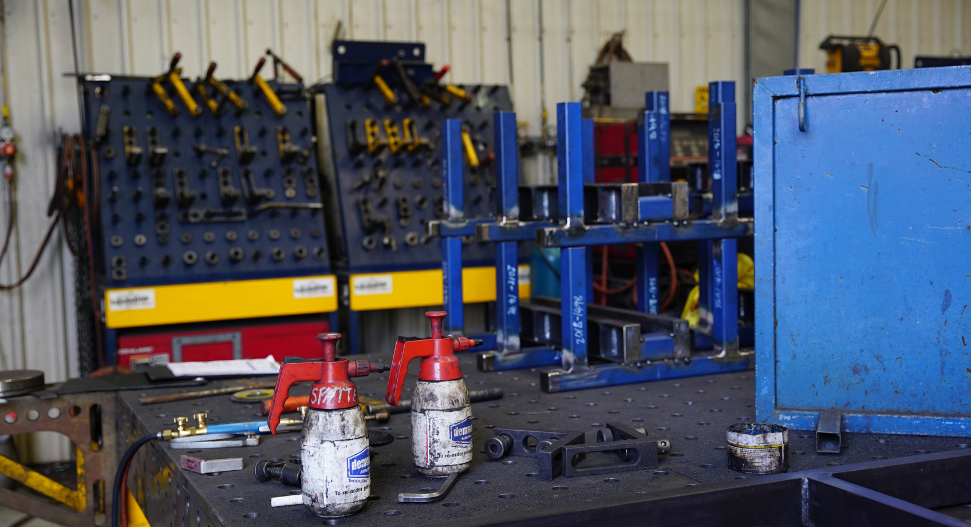
Are Modular Welding Systems Worth the Investment?
Yes, modular welding systems reduce setup time, rework, and distortion, delivering long-term cost savings in production environments.
While a modular system represents a higher upfront investment than a basic table, the return is realised through faster setups, reduced scrap, and improved consistency. Over time, these benefits significantly lower the cost per part, especially for repeat or multi-part builds.
How Accurate Are Modular Welding Tables?
High-quality modular welding systems achieve positioning accuracy of ±0.05 mm, depending on configuration.
Accuracy is critical when fabricating components that must fit or align with other assemblies, particularly where achieving a quality weld is essential for downstream assembly or inspection. Precision-machined hole grids and hardened surfaces allow parts to be positioned and repositioned without cumulative error, ensuring dimensional consistency across production runs.
Can a Welding System Be Reconfigured for Different Jobs?
Yes, modular welding systems are designed to be quickly reconfigured for different parts, assemblies, or production runs.
Unlike fixed jigs, modular systems can be dismantled and rebuilt to suit new jobs. This flexibility is particularly valuable for workshops handling prototypes, short runs, or varied contract work without sacrificing accuracy.
What Industries Benefit Most from Welding Systems?
Industries requiring accuracy and repeatability — such as mining, transport, defence, and general manufacturing — benefit most from welding systems.
These modular platforms are widely used in industries where consistent quality and dimensional control are required. They support a wide range of types of welding and welding methods used in both bespoke fabrication and production environments.
How Do Welding Systems Reduce Distortion?
By securely fixturing components in precise positions, welding systems control heat input and minimise movement during welding.
Distortion occurs when components move under heat. A modular fixturing setup effectively restrains parts, reducing movement and the need for post-weld straightening, saving time and preserving dimensional accuracy.
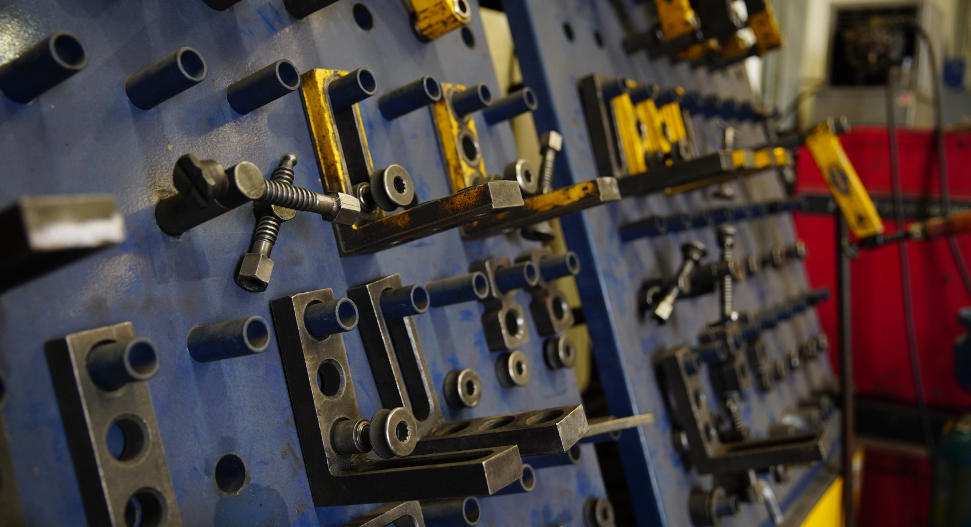
What Accessories Are Essential in a Modular Welding System?
Clamping elements, stops, angles, and risers are essential accessories in a modular welding system.
Modular welding table accessories enable complex geometries to be positioned accurately without fabricating custom fixtures. The right accessory set transforms a table into a flexible, production-ready system capable of handling diverse fabrication challenges.
Can Welding Systems Support Automation or Robotics?
Yes, modular welding systems provide a stable, repeatable base ideal for robotic or semi-automated welding processes.
Automation relies on consistent part positioning. Modular welding systems deliver the repeatability required for robotic welding, enabling manufacturers to transition from manual to automated processes with confidence.
How Do Welding Systems Improve Production Efficiency?
Modular systems improve efficiency by reducing setup time, minimising rework, and enabling repeatable workflows.
By standardising setups and eliminating guesswork, welding systems allow skilled tradespeople to focus on welding rather than alignment. The result is faster throughput, predictable quality, and better use of labour.
Additional Considerations When Choosing a Welding System
When a Welding System May Not Be Required
A modular welding solution is not always necessary for low-volume, non-repeatable, or tolerance-insensitive fabrication work.
For workshops producing one-off components with generous tolerances, a basic welding table may be sufficient. In these cases, the time savings delivered by modular fixturing may not justify the initial investment.
However, once fabrication involves repeat parts, multiple operators, or components that must align with mating assemblies, a welding system becomes a practical requirement rather than an upgrade.
Common Specification Pitfalls to Avoid
One of the most common issues is specifying a welding system based solely on current workloads rather than future requirements.
Typical pitfalls include:
- Selecting a table size that limits part orientation
- Underestimating the range of modular accessories required
- Treating the system as a static table rather than a reconfigurable platform
Industrial-grade modular systems, such as those from Demmeler, are designed to scale over time. Correct specification ensures the system remains effective as production demands change.
System Sizing and Configuration Considerations
Correct system selection depends on more than table dimensions.
Key considerations include:
- Maximum component size and weight
- Required positional accuracy
- Frequency of repeat jobs
- Need for multi-axis or vertical fixturing
A welding system should be configured as a complete platform — table, accessories, and workflow — rather than selected as an isolated product.
Why Integration Matters as Much as the Equipment
The value of a welding system is realised only when it is properly integrated into workshop processes.
Effective implementation considers:
- Operator workflow and setup repeatability
- Inspection and verification requirements
- Training and long-term usability
Leussink applies modular welding systems within its own engineering and fabrication operations, ensuring each system is specified with real-world production environments in mind.
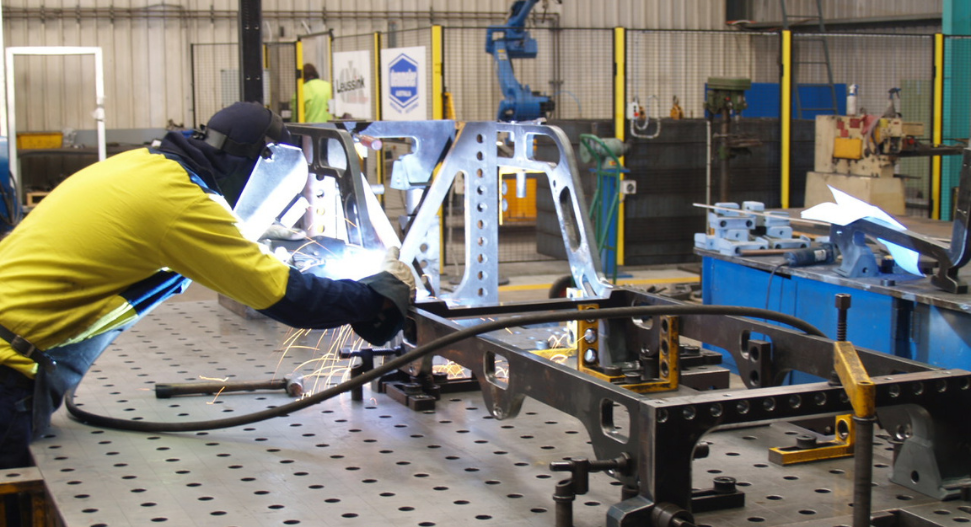
Why Choose a Demmeler Welding System Through Leussink Australia
Leussink doesn’t just supply welding systems — we use them. Our team works with manufacturers to:
- Specify the right Demmeler welding system for the application
- Configure modular accessories and layouts
- Support long-term scalability and accuracy
This practical, engineering-led approach ensures each system delivers real performance improvements, not just equipment on the workshop floor.
Contact Leussink About Your Welding Application
If you’re evaluating whether a modular system is right for your operation, Leussink can help you assess your requirements and configure a solution that delivers measurable results. Whatever your welding questions, we have the answers.
Other News
Small Parts Machining: Why Leussink Takes On the Small Jobs Too
Written by Stuart Ward, Sales and Marketing Manager at Leussink...
Written by Stuart Ward,...
Leussink Joins Omega Sinto Foundry Machinery at AFI 2026
Leussink will be at AFI 2026, the Australian Foundry Institute's...
Leussink will be at...

In-House vs Outsourced CNC Machining
In-House vs Outsourced CNC Machining: How to Make the Right...
In-House vs Outsourced CNC...
Casting CNC Machining
Why Casting CNC Machining Is Essential for Australian Foundries Precision...
Why Casting CNC Machining...
Why End-to-End Engineering Wins for Industrial Facilities
End-to-end engineering means working with one engineering partner across every...
End-to-end engineering means working...
CNC Machining vs Manual Machining for Heavy Industry: When Each Method Wins
Quick Answer: CNC machining vs manual machining is a project-by-project...
Quick Answer: CNC machining...
Emergency CNC Machining: What Actually Happens When Critical Equipment Fails?
It’s 2am. A bearing on the main drive has failed,...
It’s 2am. A bearing...
7 Australian Foundry Production Problems (And How Engineering Support Solves Them)
Most Australian foundries don't lose performance overnight. They lose it...
Most Australian foundries don't...
What Makes CNC Machining Essential for Heavy Industry Applications in Australia?
When a critical component fails in a mining operation or...
When a critical component...
How Does Large-Scale CNC Machining Handle Complex Component Production?
Large-scale CNC machining is not simply conventional CNC applied to...
Large-scale CNC machining is...