
CNC Machining vs Manual Machining for Heavy Industry: When Each Method Wins
Posted on: 13/07/2026 Read time: 12 minutes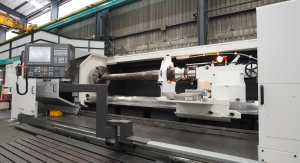
Quick Answer: CNC machining vs manual machining is a project-by-project decision in heavy industry. CNC wins for repeatable precision (±0.005 mm or tighter), complex geometry, and production volume. Manual wins for urgent breakdowns, oversized work outside the CNC envelope, and quick-turn modifications (typically ±0.05 mm with a skilled operator). The strongest Australian suppliers operate both methods.
Behind that headline answer sits a more practical question: what does the wrong choice actually cost? Tolerance error, downtime, and rework scale with component size, operating load, and how urgently the part needs to return to service. The decision logic on any specific heavy industrial project involves more than production volume, which is where most generic comparisons stop.
This guide breaks down the comparison between CNC machining and manual machining methods specifically for heavy industrial projects across mining, steel processing, energy, defence, and large-scale fabrication. It covers where each method outperforms the other, where they work best together, and how Australian engineers approach the manual vs CNC machining call on real projects.
Manual vs CNC Machining at a Glance for Heavy Industrial Projects
CNC machining excels in repeatability, micron-level tolerances across complex geometries, and continuous, high-volume throughput. Manual machining wins for urgent, one-off repairs, oversized work outside the CNC envelope, finishing operations of jigs and fixtures, and quick-turn modifications to existing components. In Australian heavy industry, the strongest engineering providers operate both methods under one roof.
| Factor | CNC Machining | Manual Machining |
| Best for | High-volume production runs, complex geometries, precision-critical components | One-off parts, oversized work, jig and fixture finishing, quick-turn modifications |
| Precision basis | Computer-controlled, removes human variability | Operator-skill dependent, hand-eye control during the cut |
| Tolerance range | ±0.005 mm or tighter, consistent across runs | ±0.05 mm typical with a skilled operator |
| Set-up time | Longer (programming, fixturing, validation) | Shorter (no programming, direct set-up) |
| Production speed | Faster at volume once running | Faster for a single part, slower at scale |
| Repeatability | Identical parts run after run | Minor variation between parts |
| Operator skill | CNC programming, CAM, machine set-up, metrology | Hand-eye coordination, feel for the cut, material judgement |
| Material flexibility | Wide, but constrained by the program | Wide, with on-the-fly adjustment |
| Cost profile | Higher capex, lower per-unit at volume | Lower capex, higher per-unit at low volume |
| Documentation | Native digital traceability | Manual sign-off, hand-measured |
| Failure recovery | Slower (program review, re-machining) | Faster (re-cut on the spot) |
| Footprint | Larger, requires handling infrastructure | Smaller, lighter installation |
What is Manual Machining in a Heavy Industrial Context?
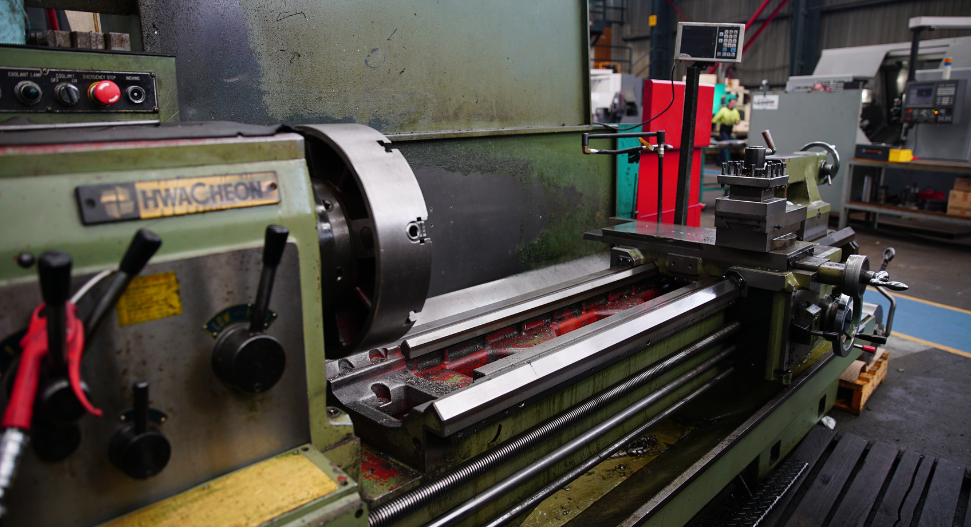
Manual machining is the process of shaping metal components using operator-controlled equipment, including manual lathes, manual milling machines, drill presses, and surface grinders. The machinist directly controls feed rate, depth of cut, and tool path through hand wheels and levers, drawing on training and physical feedback rather than pre-programmed instruction.
In a heavy industrial setting, manual machining is the foundational discipline behind almost every senior CNC operator. Australian apprenticeships traditionally introduce manual lathes, mills, and surface grinders before progressing to CAM and multi-axis CNC work, and that technical foundation matters: when a CNC program fails mid-run on a high-value component, the operator who can diagnose and finish the part by hand is the one who saves the job.
What is CNC Machining and How Does It Differ?
CNC machining is the computer-controlled, subtractive machining process in which pre-programmed software dictates tool movement, feed rate, and depth of cut across multiple axes. Components are produced from CAD files translated into CAM-generated G-code, executed by lathes, mills, grinders, and wire cutters, with limited human intervention during the cycle.
The core distinction between CNC and manual machining methods lies in automation. CNC removes the operator’s continuous input from the cutting process, replacing it with programmed precision. Manual machining keeps the operator’s judgement embedded in every pass.
Where CNC Machining Wins for Heavy Industrial Projects
For most modern heavy industrial production, CNC machining is the default choice for clear, measurable reasons. The benefits of CNC machining at scale are well documented; the advantages of CNC machining for heavy industry, specifically, fall into five distinct categories.
Precision Through Computer Control
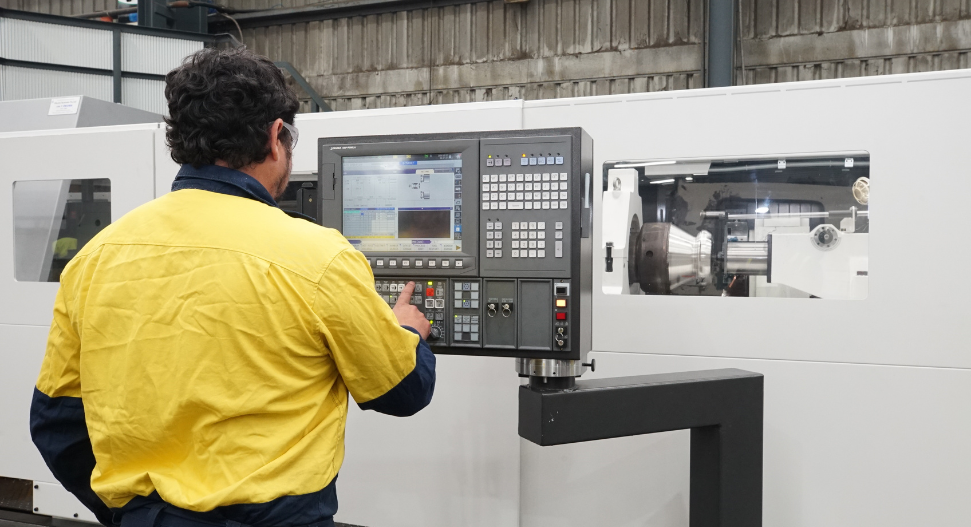
The defining advantage of CNC machining is computer-controlled precision. Where manual machining depends on operator skill and physical feedback during the cut, CNC executes every movement against programmed coordinates, eliminating the variability that produces dimensional drift across a workpiece. For heavy industrial components where a deviation of microns affects fit, sealing, or rotational balance under load, CNC is the only practical method.
Repeatability Across Production Runs
Once a CNC program is proven, every component off the machine matches the first one to within microns. For high-volume work in defence, energy generation, and component manufacturing, this consistency is a contractual requirement. A single out-of-spec part in a run of two hundred can mean rejection of the entire batch.
Tight Tolerances on Complex Geometry
Multi-axis CNC milling and turning hold tolerances that hand machining cannot maintain across complex three-dimensional geometry. Mining, oil and gas, and steel processing equipment increasingly demand features such as compound angles, deep pocketing, and contoured surfaces that only multi-axis programming delivers reliably at production tolerance.
Continuous Throughput on Large Parts
Where a heavy industrial component has been programmed and proven, CNC machines run unattended through long cutting cycles. A part that would tie up a skilled manual machinist for two shifts can run overnight with one operator monitoring multiple machines. This is the high volume CNC machining argument at scale.
Documentation and Traceability
Defence and energy contracts often require full machining traceability: cutter selection, feed rates, coolant temperature, and dimensional verification at specified intervals. CNC systems generate this documentation natively. A manual machining log signed by the operator can match the output, but only with dedicated paperwork discipline at the bench.
Where Manual Machining Still Wins in Heavy Industrial Work
Despite the dominance of CNC in modern manufacturing, manual machining remains the preferred method in several heavy industrial scenarios. This is the part of the conversation most generic comparisons get wrong: the question is not whether CNC has surpassed manual machining (it has, for the work it is designed to do), but where manual machining still outperforms CNC.
Equipment Breakdown Repairs and Urgent One-Offs
When a critical part fails, the cost of downtime usually outpaces the cost of the component by an order of magnitude. In these situations, the time required to model the part, generate CAM toolpaths, prove the program, and machine the replacement is the time the plant is not operating. Manual machining is the most practical method when under critical time pressure. A skilled manual machinist can cut a replacement from raw stock while a CNC programmer is still drafting the model.
Components Beyond the CNC Envelope
Every CNC machine has a defined work envelope, with hard limits on diameter, length, and component mass. Heavy industrial work regularly produces components that exceed those constraints. When a section of mill stand, a forge die, or a large bearing housing falls outside CNC capacity, manual machining (often via portable equipment used on-site) becomes the only path forward. Leussink’s on-site machining capability is designed for exactly this scenario.
Jig, Fixture, and Pattern Finishing
CNC machines need workholding, and the workholding itself – whether jig, fixture, or weldment – often requires manual finishing. Fitters and machinists who can adjust, scrape, or lap a fixture to a datum surface deliver tolerance control that no CNC operation can replicate efficiently for a one-off set-up. The same applies to foundry patterns, mould inserts, and welded sub-assemblies, where the final fit cannot be programmed in advance.
Quick-Turn Modifications
When a component arrives at the workshop needing minor modification, such as milling a slot, drilling an additional hole, or opening a bore by 0.5mm, the manual machinist completes the work in minutes. The CNC equivalent would require set-up, fixturing, and proving – none of which a job of this size justifies.
Hybrid CNC and Manual Machining Workflows
The most common pattern in Australian heavy industrial work is not CNC instead of manual, or manual instead of CNC. It is both methods deployed in sequence by the same team. The economic argument for keeping both capabilities under one roof rests on this hybrid approach.
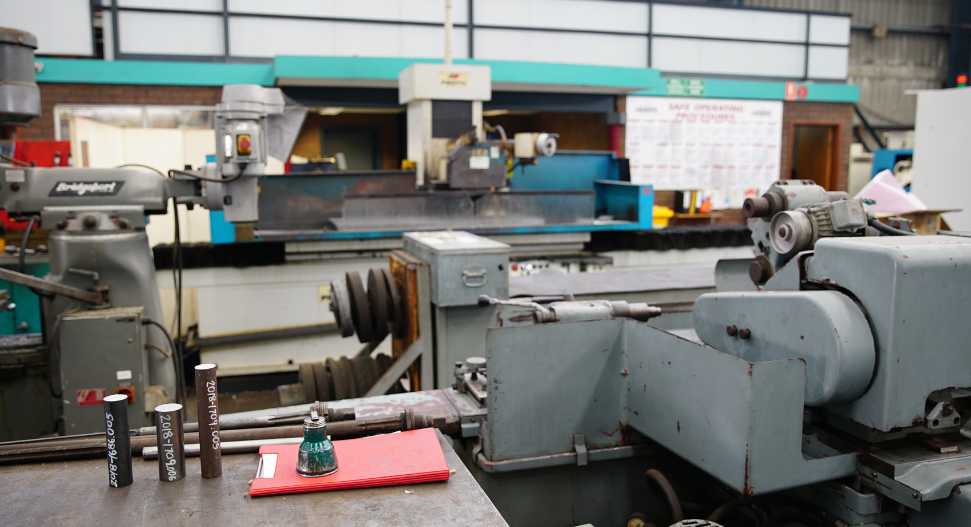
A typical hybrid workflow for a complex heavy industrial component proceeds as follows. CNC machining produces the primary geometry: bores, faces, mounting features, and threaded holes. Manual machining then handles finishing operations: hand-fitting bearing seats, dressing weld zones, scraping mating surfaces to verify tolerance, and modifying as the assembly is trial-fitted to its partner component. Metrology validates the finished part against specification, with portable measuring arms used where the component is too large or too integrated to move.
Leussink delivers this integrated workflow because the same engineering team controls CNC machining, fabrication, welding (on exclusive Demmeler welding systems), and metrology validation (via Tomelleri portable measuring arms) under one roof. For heavy industrial clients, this removes the need for supplier coordination and shortens lead times – the most expensive overhead in any complex machining job.
How to Choose Between CNC and Manual Machining for Heavy Industrial Projects
The following decision matrix reflects the actual criteria Australian engineers apply to the CNC machining vs manual machining call on heavy industrial projects. It’s the framework Leussink uses on every incoming enquiry, ensuring we make a manual vs CNC machining recommendation based on real project conditions rather than supplier convenience.
| Project condition | Choose CNC | Choose Manual | Choose Hybrid |
| Production volume | More than 5 identical parts | 1 to 3 parts | Prototype + production run |
| Tolerance requirement | Micron-level, repeating | Wider (0.05mm and above), single part | Tight on key features, manual finish elsewhere |
| Geometry complexity | Multi-axis features, contoured surfaces | Simple turning or milling | Complex form plus manual fit |
| Lead time | Days to weeks (program plus run) | Hours (urgent breakdown) | Mixed urgency |
| Component size | Within CNC envelope | Exceeds CNC capacity | Sub-assemblies fit, full assembly does not |
| Drawing availability | Full CAD or CAM package | Drawing-less reverse engineering | Partial data, manual reconstruction |
| Material | All standard alloys | All standard alloys, plus exotic legacy | All materials |
| Documentation | Full traceability required | Limited paperwork acceptable | Full traceability on CNC operations |
| Set-up cost justification | High (volume balances set-up) | Low (no programming overhead) | Justified for high-value components |
Most heavy industrial projects fall into the hybrid column once a supplier is honest about what each method actually does best. Suppliers who only offer CNC will route everything through CNC. Suppliers who only operate manual machines will under-deliver on volume work. The strongest position for an Australian heavy industrial business is to work with an engineering provider operating both methods routinely, with CNC machining capabilities and manual machining capabilities deployed against the specific demands of each job.
Cost Considerations: CNC vs Manual Machining
Headline unit pricing is rarely the deciding factor for heavy industrial buyers. The real cost comparison is total cost of ownership across the component’s life cycle.
CNC machining carries a higher capital and set-up cost per job. Programming time, fixturing design, first-article verification, and machine time are all charged before the first acceptable part comes off the machine. At volume, these costs get absorbed quickly. For single parts, they do not.
Manual machining inverts the cost profile. Set-up is fast and inexpensive, but labour cost per part remains constant across the run. A skilled manual machinist costs the same whether they’re producing one part or one hundred. There is no economy of scale.
For heavy industrial businesses, three further cost factors matter as much as direct machining cost:
- Downtime cost (the value of plant uptime saved by a fast manual repair against a slower CNC reproduction) is often the largest single number in the calculation.
- Rework cost (the price of a CNC program error against a manual misjudgement) varies by operator skill and program maturity.
- Supplier coordination cost (the overhead of moving a component between specialist suppliers) is eliminated entirely when CNC and manual capability sit under one roof.
Why Australian Engineers Choose Leussink for Heavy Industrial Machining
For more than 40 years, Leussink Engineering has operated CNC and manual machining capabilities side by side from our Unanderra facility in the NSW Illawarra, serving heavy industrial clients across Australia and New Zealand. As a second-generation family-run business, our engineering team carries the institutional knowledge to handle work that falls outside standard catalogue capability: legacy components, urgent breakdowns, oversized parts, and complex hybrid jobs that require both CNC precision and manual finishing.
Our integrated capability spans:
- Precision CNC machining across milling, turning, wire cutting, and surface grinding (17 next-generation machines under one roof, including the only Zayer Memphis 4000 in any Australian job shop)
- Manual machining for breakdown response, oversized work, and expert finishing
- Integrated welding and fabrication on Demmeler welding systems (Australian-exclusive)
- In-house and on-site metrology validation using Tomelleri portable measuring arms (Australian-exclusive)
- Foundry equipment supply via Omega Sinto (Australian-exclusive)
- On-site machining services where the component cannot leave site
- 24/7 equipment breakdown response across mining, steel, energy, defence, and large-scale fabrication
For Australian heavy industrial businesses weighing CNC machining vs manual machining for a specific project, the conversation Leussink prefers to have is the third option: which combination of both methods, with which finishing, validated against what tolerance, will produce the most reliable result for the lowest total cost. Get in touch to see how Leussink can support your project with machining excellence.
Frequently Asked Questions
What Is the Difference Between CNC and Manual Machining?
When Should You Use Manual Machining Over CNC?
Is Manual Machining Still Used in Australian Heavy Industry?
Is CNC Machining Better Than Manual Machining?
What Is the Difference Between a CNC Machine and a Manual Lathe?
Other News
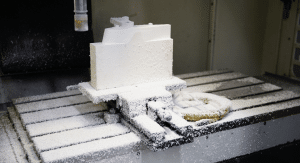
Small Parts Machining: Why Leussink Takes On the Small Jobs Too
Written by Stuart Ward, Sales and Marketing Manager at Leussink...
Written by Stuart Ward,...
Leussink Joins Omega Sinto Foundry Machinery at AFI 2026
Leussink will be at AFI 2026, the Australian Foundry Institute's...
Leussink will be at...

In-House vs Outsourced CNC Machining
In-House vs Outsourced CNC Machining: How to Make the Right...
In-House vs Outsourced CNC...
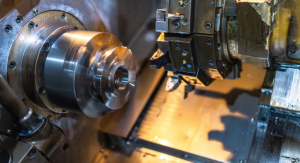
Casting CNC Machining
Why Casting CNC Machining Is Essential for Australian Foundries Precision...
Why Casting CNC Machining...
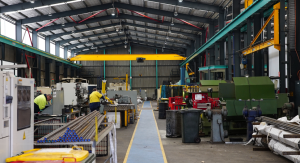
Why End-to-End Engineering Wins for Industrial Facilities
End-to-end engineering means working with one engineering partner across every...
End-to-end engineering means working...
CNC Machining vs Manual Machining for Heavy Industry: When Each Method Wins
Quick Answer: CNC machining vs manual machining is a project-by-project...
Quick Answer: CNC machining...
Emergency CNC Machining: What Actually Happens When Critical Equipment Fails?
It’s 2am. A bearing on the main drive has failed,...
It’s 2am. A bearing...
7 Australian Foundry Production Problems (And How Engineering Support Solves Them)
Most Australian foundries don't lose performance overnight. They lose it...
Most Australian foundries don't...
What Makes CNC Machining Essential for Heavy Industry Applications in Australia?
When a critical component fails in a mining operation or...
When a critical component...
How Does Large-Scale CNC Machining Handle Complex Component Production?
Large-scale CNC machining is not simply conventional CNC applied to...
Large-scale CNC machining is...