
Emergency CNC Machining: What Actually Happens When Critical Equipment Fails?
Posted on: 09/07/2026 Read time: 10 minutes
It’s 2am. A bearing on the main drive has failed, the line is down, and the OEM is quoting a six-week lead time for the replacement. Every hour the plant is offline costs more than most people in the room earn in a year. What happens next is a discipline of its own.
This piece is for the operations and maintenance leads who have already lived through that phone call – or who would prefer to think it through before they do. It covers why breakdown costs are higher than they appear, where they actually come from, and what separates a useful emergency machining partner from one that adds delay.
Key Takeaways
- Unplanned downtime costs industrial businesses up to $500,000 per hour, with Australian operators running at almost double the global average. For heavy industry, the hourly figure has risen fourfold since 2019.
- Most breakdowns trace back to six recurring causes: lubrication failure, component wear, electrical faults, operational overload, deferred maintenance, and operator training gaps.
- What determines emergency lead time is not the cut itself. It is the gap between intake and first cut, which is decided by who can model, source material, and verify under the same roof.
Why a $500,000-an-Hour Machine Breakdown Is Rarely the Real Cost
ABB’s October 2025 global survey of 3,600 industrial decision-makers found unplanned downtime now costs industrial businesses up to $500,000 per hour, with 14% of companies experiencing weekly breakdowns. Australian operators sit at the upper end of that global range, with downtime costs close to double the international average. For heavy industry specifically – steel, mining, chemicals – the hourly figure has risen fourfold since 2019. However, these numbers understate the full exposure.
The visible cost is the production hour. The invisible costs land on the operations team a week later: expedited freight on the OEM part that finally turned up, premium overtime labour, missed contractual commitments, scrap on partially-processed material in adjacent units, and the reputational cost of late deliveries to customers who do not care why the line was down. None of that appears on the hourly downtime calculator.
The picture across heavy industry has not improved with technology spend. Even with widespread investment in maintenance tools and AI, 79% of maintenance teams report unplanned production downtime stayed the same or increased over the past year, and 39% of leaders now say each downtime event is more expensive than the year before. The point is not that prevention eliminates breakdowns. It is that response capability determines how expensive the breakdowns you do have actually become.
Six Common Causes of Steel Plant and Mining Equipment Breakdown
Regardless of asset type, most machine breakdowns trace back to the same handful of root causes. The list below draws on what we see across mining, steel, foundry, and heavy fabrication sites in Australia and New Zealand.
- Lubrication failure and contamination. Inadequate, contaminated, or wrong-grade lubricant is the most reliable predictor of an unplanned outage. Friction generates heat, heat erodes surfaces, and the failure mode is rarely the lubricant itself – it is the bearing, gear, or shaft that fails because the lubricant did its job poorly.
- Component wear past tolerance. Mechanical wear is the cost of doing business in heavy industry. The breakdown event is the day the wear curve crosses the tolerance line on a critical component, often a bearing, drive shaft, gear set, or sealing surface.
- Electrical and control system faults. Motors, drives, contactors, and PLCs do not wear like mechanical parts, but they do fail – often suddenly. Electrical faults are also the most common cause of safety-driven shutdowns, where the part is fine, but the safety system has locked the line out until the fault is cleared.
- Operational overload. Pushing a machine at the upper end of its rated envelope for sustained periods shortens the service life of every component in the load path. Steel mills running above nameplate during contract surges and mining trucks operating outside design temperature ranges are the most common Australian examples.
- Deferred or skipped maintenance. Scheduled maintenance that gets bumped during a busy quarter has a way of cashing in three months later as an unplanned breakdown. The cost difference between catching a wearing component on a planned shutdown and replacing it under emergency conditions is typically an order of magnitude.
- Operator training and handover gaps. Lack of experience is a common cause of machine breakdowns. Australian operations with high rotation, multi-shift handover, or contractor-heavy crewing are particularly exposed.
These causes matter for one reason: regardless of which one is the trigger, the response window that follows is what determines the actual cost. That is where emergency CNC machining and reverse engineering services enter the picture.
What Really Determines Lead Time on Emergency Machined Parts?
Operations leads tend to ask the wrong question first. The instinctive question is ‘how fast can you machine it?’ The right question is ‘how fast can you start machining it?’ On a non-complex component, the actual cut on a multi-axis CNC machine is usually a small fraction of the total turnaround time. The lead-time killer is everything that happens before the first chip lands on the workshop floor.
Three things move that timeline.
- First, whether the design exists in a usable form – drawings, CAD model, or a damaged part that can be reverse-engineered.
- Second, whether the right material is on the shelf or has to be sourced.
- Third, whether the supplier can run material sourcing, CAD work, FEA, and tool set-up in sequence. That parallel-workflow discipline is what urgent part manufacturing actually is.
This is the practical case for emergency machine services that sit inside a single integrated facility. When CNC machining, metrology, fabrication, and mechanical design live under one roof – as they do at Leussink’s Wollongong workshop – the gap between intake and first cut compresses from days to hours. The cut itself does not get faster. The lead-time math does.
Reverse Engineering Services: When You Have No Drawings or Time
The hardest emergency machining job is the one where the design intent walked out the door with the original OEM in the ‘90s. Legacy mining and steel assets are full of components that were custom-engineered, lightly documented, and never redrawn after the first revision. When a part on one of those assets fails, the conventional response is to wait for an obsolete-part lookup, hope it returns a hit, and accept whatever lead time results.
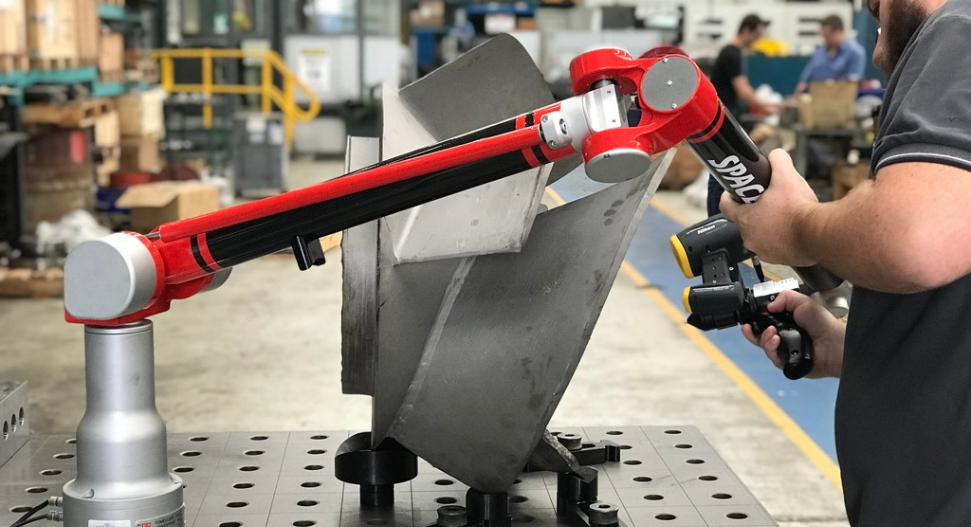
Reverse engineering a damaged component inverts that sequence. It reconstructs the full design from the damaged part itself, meaning the timeline depends on measurement quality, not OEM availability. The work begins with dimensional capture. Portable metrology arms (we use the Tomelleri system) can travel to sites for components too large or too embedded in plants to remove. Where the part can be returned to the workshop, fixed coordinate measuring machines and 3D scanning capture geometry to sub-micron accuracy. That data lands in CAD, where Finite Element Analysis validates the part against its expected load case before any material is cut.
Reverse engineering also creates an opportunity most operators do not take advantage of: the chance to upgrade the failure point. Most repeating bearing failures trace back to an unaddressed service-life weakness in the original design. The weakness survives every replacement because no event has forced a redesign. A reverse-engineered replacement can carry harder materials, tighter tolerances, or a small geometry change that addresses the root cause, so the next failure is no longer inevitable.
The Material Decision Most Plants Get Wrong During a Breakdown
There is a default reflex in emergency machining: match the OEM material exactly. The reflex is sometimes right and sometimes the most expensive mistake on the brief. Specifying an exotic OEM grade – duplex stainless, Inconel, a hardened tool steel that ships from one mill in Europe – can add three days of material lead time to a 24-hour machining job.
The better question is whether the failure mode demands the OEM material, or whether a fit-for-purpose alternative held in stock will return the asset to service within the actual downtime tolerance. Plants that work this through with an engineering partner upfront, in writing, recover hours that the OEM-spec reflex would have cost them. Plants that do not wait for the freight.
Most production-grade alloy steels, stainless grades, tool steels and structural aluminium are commonly available through established Australian distributor networks within 24 to 48 hours, depending on location. The exotic grades are not, and that is the trade-off worth flagging before the first call to the OEM.
Five Questions to Ask Your Emergency Machining Partner Before You Need One
The worst time to vet an emergency machine service provider is during the breakdown. The conversation has to happen earlier. These five questions cover most of what matters:
- Do you have in-house metrology and CNC machining on the same site?
Vendor chains that separate measurement, design, and machining add a handoff at every step. Same-site capability is the practical difference between an emergency machining services quote in hours and one in days.
- Can you reverse-engineer from a damaged part, on-site if necessary?
Portable metrology capability decides whether the response begins on the plant floor or only after the broken part has been freighted to a workshop.
- What is your working stock of common engineering materials?
If the answer is ‘we order in’, the material clock starts the moment the call lands – which usually means a day lost before anything is machined.
- How is the replacement part verified before it leaves the workshop?
Dimensional verification on a coordinate measuring machine with a written report should be standard. If it is not, fit and finish problems on re-commissioning become your problem, not the supplier’s.
- Will you attend site, and what does that escalation look like?
For larger assets, the answer matters. If the part cannot leave the plant, neither can the response.
If the answer to any of these is no, that vendor is a fall-back, not a primary. At Leussink, we answer the call that many other providers won’t. In times of emergency, knowing your partner is equipped with the capabilities, expertise, and understanding you need to get your site operational rapidly is critical
How to Prevent Machine Breakdown: Why Prevention Still Beats Response
Everything above is about the response window. None of it should be read as an argument for tolerating preventable failures. The most cost-effective answer to how to prevent machine breakdown is the dull one: condition monitoring, planned shutdowns, vibration analysis, oil sampling, thermal imaging, and a maintenance schedule that nobody is allowed to defer when the production calendar tightens.
CNC machine breakdown prevention sits inside that broader programme. Pre-positioning critical spare drawings, holding reverse-engineered CAD models for legacy components, and running a baseline inspection on high-risk wear points all push the failure curve to the right. None of that removes the case for emergency machining capability. It just makes sure that the capability is being used as an exception, not a routine.
The blunt rule: any maintenance team relying on emergency response as its first line of defence is paying a margin every quarter that prevention would have absorbed for a fraction of the cost.
Speak to a Leussink engineer about planning regular maintenance.
Frequently Asked Questions
How Quickly Can an Emergency CNC-Machined Part Be Produced?
Can Replacement Parts be Made Without Original Drawings?
What Industries Does Leussink Support with Breakdown Machining Services?
Does Emergency Machining Cover Exotic Materials?
How is a Replacement Part Verified Before Dispatch?
Can Emergency Machining Engineers Attend Site for a Breakdown Response?
Other News
Small Parts Machining: Why Leussink Takes On the Small Jobs Too
Written by Stuart Ward, Sales and Marketing Manager at Leussink...
Written by Stuart Ward,...
Leussink Joins Omega Sinto Foundry Machinery at AFI 2026
Leussink will be at AFI 2026, the Australian Foundry Institute's...
Leussink will be at...

In-House vs Outsourced CNC Machining
In-House vs Outsourced CNC Machining: How to Make the Right...
In-House vs Outsourced CNC...
Casting CNC Machining
Why Casting CNC Machining Is Essential for Australian Foundries Precision...
Why Casting CNC Machining...
Why End-to-End Engineering Wins for Industrial Facilities
End-to-end engineering means working with one engineering partner across every...
End-to-end engineering means working...
CNC Machining vs Manual Machining for Heavy Industry: When Each Method Wins
Quick Answer: CNC machining vs manual machining is a project-by-project...
Quick Answer: CNC machining...
Emergency CNC Machining: What Actually Happens When Critical Equipment Fails?
It’s 2am. A bearing on the main drive has failed,...
It’s 2am. A bearing...
7 Australian Foundry Production Problems (And How Engineering Support Solves Them)
Most Australian foundries don't lose performance overnight. They lose it...
Most Australian foundries don't...
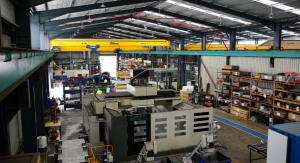
What Makes CNC Machining Essential for Heavy Industry Applications in Australia?
When a critical component fails in a mining operation or...
When a critical component...
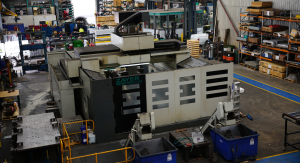
How Does Large-Scale CNC Machining Handle Complex Component Production?
Large-scale CNC machining is not simply conventional CNC applied to...
Large-scale CNC machining is...