
The Advantages of Using a Portable CMM Arm in Metrology
Posted on: 04/01/2024 Read time: 8 minutes
Across Australian workshops and manufacturing environments, the demand for faster, more flexible quality control is reshaping how metrology is performed. From heavy industry and mining to aerospace, defence, and precision engineering, teams are increasingly moving measurement out of isolated labs and onto the shop floor.
Portable CMM arms have emerged as a powerful metrology solution in this shift, enabling accurate, on-site inspection directly at the point of production. This guide explains what a portable CMM arm is, how it works, its key benefits, and what to consider before investing.
Discover the best portable CMM for your needs with our expert range of Tomelleri metrology arms – exclusively available in Australia at Leussink.
Explore Portable CMM Arms
What is a Portable CMM?
A Coordinate Measuring Machine (CMM) — sometimes called articulated measuring arms, or metrology arms — can intricately and accurately collect measurements of the surface geometry of an object.
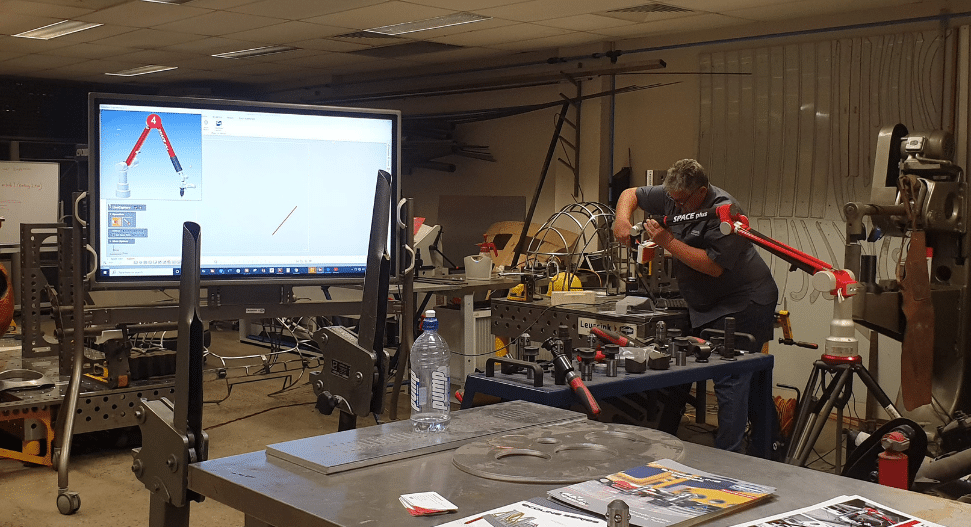
A portable coordinate measuring machine is a handheld, articulated coordinate measuring arm that captures precise 3D measurements directly from a physical object. Unlike a traditional fixed CMM, a portable arm moves freely and can be taken to the part — whether on the shop floor, in a workshop, or on-site. Each movement of the arm is tracked in real time, allowing operators to measure dimensions, verify tolerances, and compare parts to CAD data without relocating heavy or complex components.
How Do Portable CMMs Work?
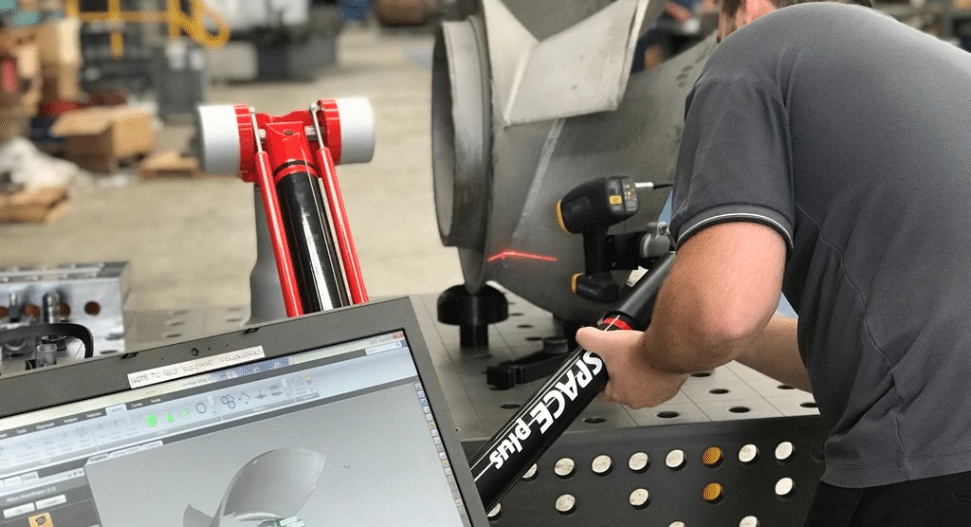
A CMM arm uses a precision probe to measure points on a workpiece. Each time the operator touches the surface with the probe, the arm records an exact 3D coordinate within the machine’s reference system. As every point is collected, the system builds an accurate digital representation of the part.
The data is transferred to CAD software, where it is used to generate a working 3D model of the part. Through automated inspection routines, the software produces clear measurement reports that highlight deviations, identify out-of-tolerance features, and support fast quality decisions on the shop floor.
Tomelleri portable CMM arms from Leussink integrate seamlessly with several leading metrology software platforms, including Aberlink and the Geomagic suite, enabling everything from dimensional inspection to full reverse engineering.
Rather than designing from a blank slate, portable metrology enables high-accuracy 3D scanning of complex geometries that are difficult or impossible to measure by hand. This captured data becomes the foundation for redesign, modification, and manufacturing, streamlining workflows across inspection, repair, and production.
Key Benefits of a Portable CMM Arm
The main benefits of a portable coordinate measuring machine (CMM) are speed, flexibility, and precision at the point of manufacture. For Australian workshops, this means fewer delays, less rework, and faster quality decisions, without the cost or complexity of a dedicated metrology lab.
Portability
Portable CMMs bring metrology to the part, allowing accurate measurement directly on the shop floor or on-site. This eliminates the need to move large or heavy components into a lab, reducing handling time and risk.
Accuracy
Modern portable CMM arms deliver high-precision 3D measurement suitable for inspection, verification, and reverse engineering. Tomelleri arms provide consistent, reliable accuracy for workshop and production environments.
Efficiency
By measuring parts at the point of manufacture, a portable CMM machine removes delays caused by transport and set-up. Operators can inspect, adjust, and verify in real time, accelerating production and decision-making.
Repeatability
Portable CMMs enable consistent measurement of the same features across parts and batches. With software-driven routines, results can be replicated with confidence by different operators.
ROI
Lower purchase costs, minimal infrastructure requirements, and reduced rework deliver fast payback. For Australian workshops, a portable CMM arm often replaces outsourced inspection and shortens production cycles, turning metrology into a profit driver rather than a bottleneck.
Portable CMM vs Traditional CMM – Which Should I Choose?
| Feature | Portable CMM Arm | Traditional CMM |
|---|---|---|
| Portability | Highly portable — can be transported to the part on the shop floor or assembly line. | Stationary — fixed installation in a controlled lab or dedicated measurement area. |
| Set-up & Flexibility | Quick set-up, flexible for varied part sizes, fixtures not always needed. | Requires fixturing, programmed routines and structured set-up. |
| Measurement Accuracy | Excellent accuracy, particularly in mid-tolerance inspections. | Generally higher level of accuracy. |
| Repeatability | Great repeatability for large-part applications. | Better equipped for high volume repeatability. |
| Speed of Use | Fast for individual parts and irregular shapes; less set-up time. | Slower initial set-up, but faster for repeated batch inspections once programmed. |
| Cost | Lower purchase cost, lower maintenance/calibration needs. | High acquisition cost and dedicated environment requirements. |
| Environment Needs | Works well on shop floors without controlled conditions. | Requires stable, controlled temperature and vibration-free lab conditions. |
What Do I Need to Know Before Buying a Portable CMM?
Before investing in a portable CMM arm, it’s important to match the system to your real-world requirements. Key considerations include:
What Level of Accuracy Do You Require?
Portable CMMs offer different levels of accuracy, so it’s essential to match the system to your tolerance requirements. Overspecifying can lead to unnecessary costs, while underspecifying can compromise quality.
The Tomelleri Mercury CMM Arm from Leussink is a 1.8m 6-Axis metrology arm. It is the most accurate volume-measuring arm currently on the market, making it ideal for workshops that require high-precision inspection.
What Are You Measuring?
Portable CMMs are classified by working volume, so before investing, it’s important to understand the dimensions, weight, and complexity of the components you need to inspect.
This is where an experienced distributor like Leussink makes a real difference. Thanks to our long-standing partnership with Tomelleri, Leussink can assess your applications and recommend the most suitable metrology arm for your part size, geometry, and workshop environment.
What Are You Trying to Achieve?
Your intended application will shape the ideal system. Are you primarily performing dimensional inspection, or do you need reverse engineering and 3D laser scanning capabilities?
Each use case places different demands on both the hardware and software. Understanding how you plan to use the measurement data — whether for quality control, redesign, or manufacturing — ensures you select a portable CMM arm and software platform that truly supports your workflow.
Choose Leussink – Sole Distributor of Tomelleri CMMs in Australia and New Zealand
Tomelleri is a world-leading Italian manufacturer with more than 30 years of experience in articulated measuring arms, and the original inventor of the technology. Continuous innovation has expanded its range to deliver greater reach, more axes, and higher performance for modern metrology.
Leussink is the sole distributor of Tomelleri metrology arms in Australia and New Zealand, supplying a complete metrology ecosystem including software, accessories, and compatible Demmeler welding tables, designed to work seamlessly together.
More than a supplier, Leussink provides end-to-end support. Our experts handle set-up, training, calibration, and ongoing technical assistance, ensuring customers achieve maximum accuracy, efficiency, and return on investment.
Backed by decades of engineering expertise, we deliver metrology solutions that stand the test of time.
For more information, call 02 4260 7777 or request a free quote online.
Frequently Asked Questions
What Parts are Best Suited to Portable Metrology?
Portable solutions are best for larger assemblies and complex or delicate components that can’t be easily transported.
How Does a Portable CMM Arm Improve Inspection?
A portable CMM arm improves inspection by bringing metrology directly to the part. Instead of moving components to a dedicated lab, operators can measure, verify, and compare parts to CAD data on the shop floor or on-site. This enables real-time quality checks, faster decision-making, and immediate correction, reducing downtime, rework, and production delays.
What Accuracy Levels Can Tomelleri Portable CMMs Achieve?
Tomelleri portable CMM arms deliver high-precision, workshop-ready accuracy suitable for inspection, verification, and reverse engineering. Depending on the model and measuring volume, Tomelleri arms achieve repeatable, micron-level performance, providing reliable results even in demanding production environments.
- Tomelleri Explorer CMM Arm: 0.065mm-0.170mm
- Tomelleri Mercury CMM Arm: 0.015mm-0.018mm
- Tomelleri Space Plus CMM Arm: 0.020mm-0.056mm
What Industries Benefit Most from Portable Metrology Arms?
Portable metrology arms are ideal for industries working with large, complex, or high-value components, including aerospace, defence, mining, heavy manufacturing, automotive, rail, and precision engineering. Any operation that needs fast, flexible, and precise measurements — especially on the shop floor or in the field — can benefit from a portable CMM arm.
Other News
Small Parts Machining: Why Leussink Takes On the Small Jobs Too
Written by Stuart Ward, Sales and Marketing Manager at Leussink...
Written by Stuart Ward,...
Leussink Joins Omega Sinto Foundry Machinery at AFI 2026
Leussink will be at AFI 2026, the Australian Foundry Institute's...
Leussink will be at...

In-House vs Outsourced CNC Machining
In-House vs Outsourced CNC Machining: How to Make the Right...
In-House vs Outsourced CNC...
Casting CNC Machining
Why Casting CNC Machining Is Essential for Australian Foundries Precision...
Why Casting CNC Machining...
Why End-to-End Engineering Wins for Industrial Facilities
End-to-end engineering means working with one engineering partner across every...
End-to-end engineering means working...
CNC Machining vs Manual Machining for Heavy Industry: When Each Method Wins
Quick Answer: CNC machining vs manual machining is a project-by-project...
Quick Answer: CNC machining...

Emergency CNC Machining: What Actually Happens When Critical Equipment Fails?
It’s 2am. A bearing on the main drive has failed,...
It’s 2am. A bearing...
7 Australian Foundry Production Problems (And How Engineering Support Solves Them)
Most Australian foundries don't lose performance overnight. They lose it...
Most Australian foundries don't...
What Makes CNC Machining Essential for Heavy Industry Applications in Australia?
When a critical component fails in a mining operation or...
When a critical component...
How Does Large-Scale CNC Machining Handle Complex Component Production?
Large-scale CNC machining is not simply conventional CNC applied to...
Large-scale CNC machining is...