
In-House vs Outsourced CNC Machining
Posted on: 20/08/2026 Read time: 6 minutes
In-House vs Outsourced CNC Machining: How to Make the Right Call
Should you machine parts in-house or send them to a specialist? It’s one of the most common questions in Australian manufacturing, and the answer isn’t always clear-cut.
Deciding between in-house vs outsourced CNC machining comes down to how much you machine, how frequently, and whether that work justifies owning the machines, the operators, and the maintenance behind them.
For most manufacturers, some work belongs in-house, and some is faster, cheaper, and lower-risk with an external specialist. This guide shows where the line sits, what each option really costs, and the choice many comparisons miss: machining carried out by contract experts on your site, not only in a workshop.
Leussink has been machining components for Australian industry for more than 40 years from our facility in the Illawarra, New South Wales. We work both sides of this decision every day, so the framework below is the one we genuinely discuss with clients.
What Do In-House and Outsourced CNC Machining Mean?
In-house CNC machining means running your own machines, operators, and quality control under your own roof. Outsourced CNC machining means sending the work to a specialist workshop that already has the equipment, the skilled personnel, and the necessary verification processes. The decision is rarely all-or-nothing – most operations split the work, keeping routine parts in-house and outsourcing the jobs that need more scale, specialist capability, or capacity than they hold internally.
Outsourcing is often called contract machining, in which a provider produces components to your drawings under an agreed arrangement. Whatever the label, the buyer is really choosing between owning a fixed solution and paying for capability on demand.
The Real Cost of In-House vs Outsourced CNC Machining in Australia
In-house machining is a capital decision. Outsourcing is an operating cost. Owning the capability means paying for the machine, tooling, floor space, skilled operators, and ongoing maintenance, whether or not the machines are cutting. Outsourcing CNC machining converts that fixed cost into a per-job price you pay only when you need a part.
The table below sets out where each option tends to win.
| Factor | In-house CNC machining | Outsourced CNC machining |
| Upfront cost | High – machines, tooling, facility | None – pay per job |
| Cost per part, low volume | High – fixed costs spread thin | Lower – no idle-asset burden |
| Cost per part, high volume | Lower once utilisation is high | Competitive, set by the contract |
| Skilled labour | You hire, train, and retain operators | Supplied by the provider |
| Machine utilisation risk | Idle machines still cost money | Carried by the provider |
| Lead-time control | Full, if capacity is free | Set with the provider; strong partners are fast |
| Capacity ceiling | Fixed by your machines | Scales with the provider |
| Large or specialist work | Limited to your envelope | Access to bigger and specialist machines |
| Maintenance and downtime | Your cost and your risk | The provider’s responsibility |
Utilisation is the hinge. A machine that sits idle still costs money, so the in-house case only stacks up when you keep the machines busy enough to absorb those fixed costs.
When Should You Choose In-House CNC Machining?
Keep machining in-house when the work is steady, repeatable, and central to what you build. The capital and staffing commitment pay back when the machines stay busy.
- High, predictable volumes of similar components.
- Simple geometries that sit comfortably within your machine’s envelope.
- Work where tight intellectual property control matters, and you want it kept behind your own doors.
- Daily design-and-prototype cycles where instant access to a machine speeds development.
The catch is constant: you carry the capital, the maintenance, and the challenge of recruiting and retaining skilled operators, whether or not the order book is full.
When Should You Outsource CNC Machining?
Outsource CNC machining when the work is occasional, oversized, complex, or beyond your current equipment and skills. A capable contract machining partner absorbs the capacity and capability gaps without the capital risk.
- Variable or one-off demand that would leave your own machines idle between jobs.
- Large or heavy components beyond your machine envelope.
- Specialist materials or tight tolerances that need specific tooling and experience.
- Breakdowns and urgent replacement parts, where turnaround matters more than unit price.
- Obsolete components with no drawings, which a partner can reverse engineer and reproduce.
- Periods when your operators are committed and you have no spare capacity.
Outsourcing machining also gives you access to larger and more advanced machines than most single sites can justify owning, which is exactly where heavy industry work tends to land.
When to Consider On-Site Machining
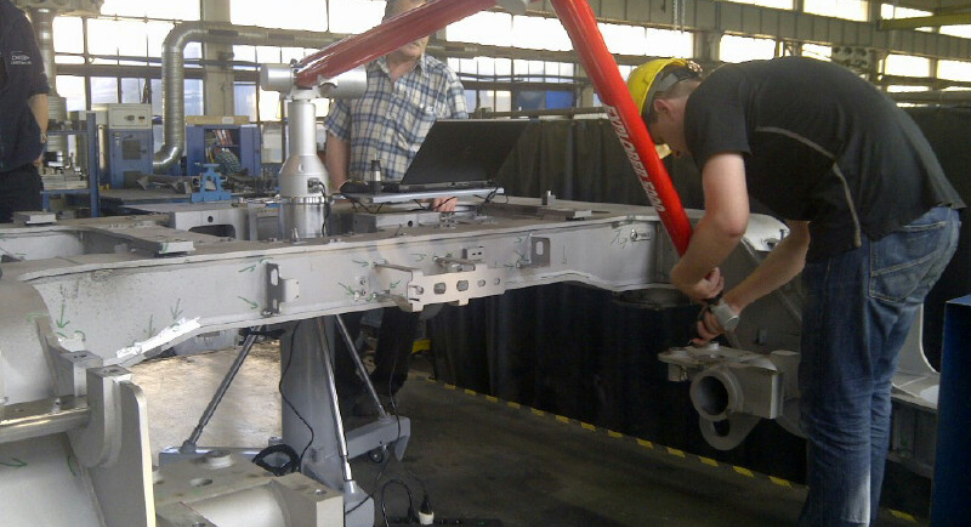
The strongest argument for keeping machining in-house is usually physical: the component is too large, too heavy, or too embedded in a fixed plant to move. On-site machining removes that argument. Instead of sending the part to a workshop, the workshop comes to the part.
Leussink brings decades of machining expertise and portable metrology solutions to your site, assesses the work in place, carries out the machining, and verifies the result against specification before leaving. On-site machining in Australia is common across mining and fixed-plant operations, where removing a large component is costly or simply not possible. The question stops being in-house or outsourced because the part never has to dictate the decision.
Why Leussink Offers Both Workshop and On-Site Machining
Most suppliers force a choice: send the part to their workshop, or keep the job in-house because it cannot travel. Leussink does both, so your hands aren’t tied.
From our Illawarra facility, we run a CNC fleet built for all kinds of industry requirements – from large and complex precision CNC machining to small-scale components – on an outsourced or contract basis. When a component cannot leave your site, that same capability travels to you through our on-site machining and portable metrology services.
Where parts are obsolete or undocumented, we reverse engineer them from samples or drawings and reproduce them to specification. When a machine is down, our team treats turnaround as the real cost and responds accordingly. Plus, every job is backed by certified quality assurance. And because Leussink is a second-generation, family-owned business, the engineers who understand your application are the same people machining the part, for clients right across Australia and New Zealand.
Frequently Asked Questions
Is it cheaper to outsource CNC machining or do it in-house?
How much does CNC machining cost per hour in Australia?
What is contract CNC machining?
Can a Leussink work on parts that cannot leave our site?
How is our intellectual property protected when we outsource?
Other News
Small Parts Machining: Why Leussink Takes On the Small Jobs Too
Written by Stuart Ward, Sales and Marketing Manager at Leussink...
Written by Stuart Ward,...
Leussink Joins Omega Sinto Foundry Machinery at AFI 2026
Leussink will be at AFI 2026, the Australian Foundry Institute's...
Leussink will be at...
In-House vs Outsourced CNC Machining
In-House vs Outsourced CNC Machining: How to Make the Right...
In-House vs Outsourced CNC...
Casting CNC Machining
Why Casting CNC Machining Is Essential for Australian Foundries Precision...
Why Casting CNC Machining...
Why End-to-End Engineering Wins for Industrial Facilities
End-to-end engineering means working with one engineering partner across every...
End-to-end engineering means working...
CNC Machining vs Manual Machining for Heavy Industry: When Each Method Wins
Quick Answer: CNC machining vs manual machining is a project-by-project...
Quick Answer: CNC machining...
Emergency CNC Machining: What Actually Happens When Critical Equipment Fails?
It’s 2am. A bearing on the main drive has failed,...
It’s 2am. A bearing...
7 Australian Foundry Production Problems (And How Engineering Support Solves Them)
Most Australian foundries don't lose performance overnight. They lose it...
Most Australian foundries don't...
What Makes CNC Machining Essential for Heavy Industry Applications in Australia?
When a critical component fails in a mining operation or...
When a critical component...
How Does Large-Scale CNC Machining Handle Complex Component Production?
Large-scale CNC machining is not simply conventional CNC applied to...
Large-scale CNC machining is...