
Small Parts Machining: Why Leussink Takes On the Small Jobs Too
Posted on: 06/10/2026 Read time: 7 minutes
Written by Stuart Ward, Sales and Marketing Manager at Leussink
Small parts machining lands on our workshop floor most weeks at Leussink, whether that’s a single replacement bolt for a stalled production line or a short run of custom brackets for a new fit-out. If you’ve assumed we only take on multi-tonne components for heavy industry, it’s an easy assumption to make – and one we’re happy to put right.
We approach a batch of ten stainless steel washers with the same rigour as a large-scale defence fabrication job, because our CNC machining process doesn’t change: understand what you need, machine it to spec, and stand behind the result. Leussink doesn’t compete with hardware stores, and we’re not trying to. We produce the part you can’t buy off the shelf, made to your drawing or sketch, with a lead time that suits your job.
What Counts as a Small CNC Machining Job?
CNC machining small parts covers any job where the part count is low, and the component doesn’t require our largest equipment to produce. That could include anything from a single one-off item through to a short run of a few hundred pieces. It’s a broad category by design, because the parts that fall into it are just as varied.
A typical week for us could include a single custom spacer machined from a hand sketch, a small-batch CNC machining run of twenty replacement bushings for an ageing conveyor system, or reverse-engineering one worn gear-tooth profile from a machine that’s been out of production for a decade. Whether we’re machining simple nuts, bolts and washers or a complex mining component, we apply the same manufacturing process and the same standard of quality control.
Material and finish don’t change the equation either. A small job might come to us in aluminium, stainless steel, brass, titanium, or a specialist alloy, and it might need anodising, plating, or a specific surface finish once it’s machined. We work with the same range of materials and finishing options on a single part as we do on a full production run.
The common thread running through all of it: you need a part that isn’t sitting on a shelf anywhere, and you need someone who can produce it accurately, without the extended lead time or restrictive minimum order quantity a small job usually attracts from a supplier geared up for high-volume runs.
Why Choose Leussink for Small Parts CNC Machining?
By choosing Leussink, you get access to over 40 years of engineering expertise and roughly 200 years of combined manufacturing experience across our workforce. That depth of knowledge is what lets us look at almost any part – large or small – and know how to produce it in the shortest timeframe and at a competitive rate.
A smaller general workshop can usually machine a simple part well enough. Bring a small job to Leussink, though, and everything around the machining changes:
- Exclusive equipment most workshops don’t have access to, including Australia’s only Zayer Memphis 4000 and our full range of Okuma-controlled CNC lathes and mills
- In-house metrology, so a critical dimension on a single part is verified to the same standard as a production batch
- Mechanical design input, when a worn or obsolete part needs re-engineering rather than simple copying
- After-sales follow-up and regular check-ins
- All of it under one roof, meaning a small machining job can turn into fabrication, on-site repair, or reverse engineering without bringing in a second supplier
Picture a single obsolete bearing housing on a piece of plant that’s been running for fifteen years. A general workshop can often machine a like-for-like copy. However, they usually can’t verify the original to the required tolerance, flag a design weakness that caused the original to fail, and then check in with you six months later to see how the replacement is holding up. That’s the difference a small job gets at Leussink.
The Small Jobs We Take On Every Week
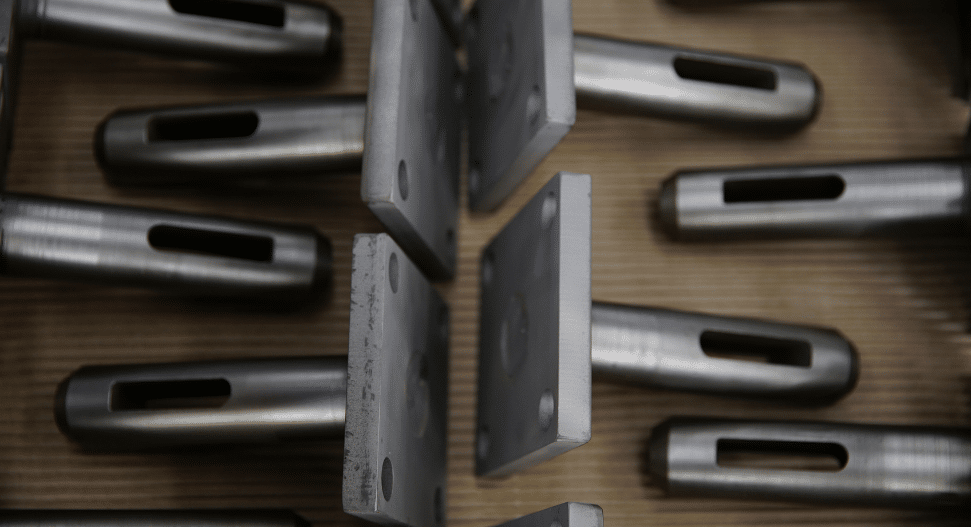
Alongside large-scale fabrication and machining, our engineers spend a large portion of their time on smaller-scale work. Some of the small jobs that come through our workshop regularly include:
- One-off CNC machining from a single drawing or hand sketch, often to replace a part with no supplier left to call
- Short-run CNC machining, from a handful to a few hundred pieces, produced to the same tolerance as a much larger order
- Single-part machining for prototypes, trial fits, or a one-time replacement
- Repairs and breakdown fixes, where a machine is down, and a single component needs to be produced or restored quickly
- Reverse engineering of a single part, built from measurement and inspection when no drawing exists at all
Which Industries Send Us Small Jobs?
Every mechanical engineering industry generates small-scale machining work sooner or later, whether you need a single valve component on a mine site or a short run part for a new production line. The hard part usually isn’t the job itself. It’s remembering that a specialist like Leussink is worth having on board.
Maintenance and reliability teams lean on small parts machining most often, usually under time pressure: a bearing housing wears out, a shaft snaps, and production is down until a replacement is available. OEMs and equipment owners are another regular source, particularly when a machine has been in service long enough that the original manufacturer no longer supports it and a single replacement part must be reverse-engineered from what’s left of the original.
We support this kind of work across mining and mineral processing, manufacturing, defence, heavy industry, and agriculture: all the same industries we serve on our larger projects. The scale of the job changes, but the standard we hold it to doesn’t.
How to Get a Small CNC Machining Job Quoted
Getting a small job quoted at Leussink starts with a PDF drawing or a hand sketch, emailed to info@leussink.com.au. You don’t need a finished technical drawing to get the conversation started. If you can describe or sketch what you need machined, our engineers can work with that.
Every quote we send includes a lead time, and once you approve it, we honour that lead time. That’s true no matter the scale of your job, and it’s a commitment we make deliberately, because a small job that runs late is often the one holding up something much bigger on your end.
Quotes are free, so there’s no reason to sit on a small job wondering whether it’s worth the call.
What to Include When You Send Us a Drawing or Sketch
A hand sketch is enough to get a small job started, but a few extra details help our engineers quote it accurately the first time, rather than coming back with questions.
- Quantity, even if it’s just one
- Material, if you know it, or a description of what the original part is if you don’t
- Any critical dimension or tolerance needed for the part to fit or function
- What the part does and where it fits, especially useful if there’s no drawing at all and we’re reverse engineering from the worn or broken original
If you’re missing any of that, send us what you have anyway. Working out the gaps with you is part of the job.
What to Expect on Turnaround for Small Jobs
Lead times for small parts machining move with our workshop’s capacity on any given day, and we manage that capacity as it changes. When capacity increases, lead times shorten. When it tightens, they grow.
We quote a lead time when we quote the job, and once you’ve given the go-ahead, that finish date is what we work towards. If you need a small job done in a hurry, tell us at the quoting stage. We’d rather manage your expectations honestly upfront than promise a date we can’t keep.
Have a small job in mind? Get in touch with our engineers today.
FAQs
Does Leussink only take on large industrial projects?
What is the smallest job Leussink will quote?
How do I request a quote for a small CNC machining job?
How long does a small CNC machining job take?
Other News
Small Parts Machining: Why Leussink Takes On the Small Jobs Too
Written by Stuart Ward, Sales and Marketing Manager at Leussink...
Written by Stuart Ward,...
Leussink Joins Omega Sinto Foundry Machinery at AFI 2026
Leussink will be at AFI 2026, the Australian Foundry Institute's...
Leussink will be at...
In-House vs Outsourced CNC Machining
In-House vs Outsourced CNC Machining: How to Make the Right...
In-House vs Outsourced CNC...
Casting CNC Machining
Why Casting CNC Machining Is Essential for Australian Foundries Precision...
Why Casting CNC Machining...
Why End-to-End Engineering Wins for Industrial Facilities
End-to-end engineering means working with one engineering partner across every...
End-to-end engineering means working...
CNC Machining vs Manual Machining for Heavy Industry: When Each Method Wins
Quick Answer: CNC machining vs manual machining is a project-by-project...
Quick Answer: CNC machining...
Emergency CNC Machining: What Actually Happens When Critical Equipment Fails?
It’s 2am. A bearing on the main drive has failed,...
It’s 2am. A bearing...
7 Australian Foundry Production Problems (And How Engineering Support Solves Them)
Most Australian foundries don't lose performance overnight. They lose it...
Most Australian foundries don't...
What Makes CNC Machining Essential for Heavy Industry Applications in Australia?
When a critical component fails in a mining operation or...
When a critical component...
How Does Large-Scale CNC Machining Handle Complex Component Production?
Large-scale CNC machining is not simply conventional CNC applied to...
Large-scale CNC machining is...