
What Is Industry 4.0 in Australia?
Posted on: 04/01/2024 Read time: 8 minutes
Industry 4.0 is the integration of digital technology into physical industrial and manufacturing processes. It connects machines, people, and data into a single system – one that can sense conditions, communicate in real time, and adapt without waiting for human instruction. For manufacturers in Australia, that shift is already well underway.
The term has its roots in Germany. In 2011, at Hannover Messe, German manufacturer Bosch used ‘Industrie 4.0’ to describe the broad integration of information and communication technology in industrial production. Each industrial revolution built on the last: the first brought steam power, the second mass production and electricity, and the third computerised manufacturing. The fourth industrial revolution Australia and other advanced economies are working through adds a connected digital layer across all of them.
Industry 4.0 encompasses the Industrial Internet of Things (IIoT) and smart manufacturing. It links physical production and operations with smart digital technology, machine learning, and big data, creating a more connected system for welding and fabrication, manufacturing, and supply chain operations.
At a recent Australian Manufacturing Week (AMW) held in Sydney, Industry 4.0 was used by many exhibitors to describe their products and services on show. Interestingly, some at AMW were also talking about ‘Industry 5.0’.
The proponents of Industry 5.0 see it as the next level of industrialisation characterised by the return of manpower. However, most – including the European Union – don’t see it as the next industrial revolution, but as a complementary facet.
What Are the Key Industry 4.0 Technologies Used in Engineering?
Industry 4.0 technologies are not a single product or platform – they’re a set of interconnected systems that, together, make manufacturing more responsive, efficient, and data-driven. The most significant for engineering and manufacturing operations include:
IIoT (Industrial Internet of Things)
Sensors and connected devices embedded in equipment capture real-time data – vibration, temperature, output rates, energy use – and transmit it to a centralised platform for monitoring and analysis. According to Rockwell Automation’s 2024 State of Smart Manufacturing Report, which surveyed 88 businesses across Australia and New Zealand, 30% have already implemented IIoT at scale.
Artificial intelligence and machine learning
AI has moved from experimentation to core operational use. Rockwell Automation’s 2026 survey of 85 AU/NZ businesses found that AI and machine learning are now the top driver of business outcomes, with 34% of operations already augmented by AI or ML. In practice, AI analyses live sensor and production data to detect defects, predict equipment failures before they occur, and surface inefficiencies that would take human operators far longer to identify.
Agentic AI
The next evolution beyond standard AI tools, agentic AI systems do not just generate recommendations – they take autonomous action within defined engineering guardrails.
A scheduling agent might expedite a production lot to meet a delivery deadline without waiting for a supervisor’s sign-off, or a maintenance agent might trigger a work order the moment sensor data crosses a threshold. In a 2025 article for Australian Manufacturing, Tim Long, global head of manufacturing at Snowflake, described this shift from AI-as-advisor to AI-as-operator as the defining industrial technology transition of 2026.
Digital twins
In digital twin manufacturing environments, a digital twin is a virtual replica of a physical asset or process. Engineers can simulate equipment behaviour and test production changes in a digital model before implementing them on the floor, reducing risk and downtime. Digital twins connected to live sensor feeds allow continuous synchronisation between the physical asset and its virtual model.
Collaborative robots (cobots)
Demand for cobots Australia-wide is growing quickly. Cobots work directly alongside people, handling repetitive or physically demanding tasks while skilled operators focus on higher-value work.
Advanced metrology
In Industry 4.0 environments, measurement and quality control are increasingly digitised. Portable metrology arms capture real-time dimensional data and feed it directly into production control processes, closing the loop between design specifications and manufactured output.
Cloud computing and big data
Large data sets from production equipment and supply chains are stored and processed in the cloud, making insights available across teams, facilities, and time zones.
Industry 4.0 in Australia – Where Is the Market Now?
Australian manufacturers are investing in Industry 4.0 technologies at a significant and accelerating rate. The pace of change since 2024 has been substantial, driven by the maturation of AI and machine learning from experimental tools into core operational systems. Successive Rockwell Automation State of Smart Manufacturing Reports have tracked this shift, with the most recent AU/NZ findings showing that 95% of surveyed businesses now view digital transformation as a business necessity rather than a competitive option.
The challenge, particularly for engineering businesses, is execution. More than a quarter of AU/NZ manufacturers identify technology paralysis as a primary obstacle to growth – a figure notably higher than the global average – pointing to the gap between intent and implementation that many businesses are still navigating.
Government investment is reinforcing the case for action. The Australian Government’s Future Made in Australia plan, the National Reconstruction Fund, and the National AI Plan collectively commit billions in targeted funding toward advanced manufacturing capability and AI deployment across industry.
For engineering businesses, smart manufacturing Australia-wide is no longer a future consideration. The businesses investing in Industry 4.0 now are building a measurable advantage in quality, output consistency, and cost control that their competitors will find difficult to close.
What Is a Cobot?
Cobots, or collaborative robots, are designed to operate directly alongside people as they perform their tasks. Unlike fully-fledged industrial robots, cobots are an accessible solution for automating processes and supporting employees without large safety infrastructure.
Cobots are responsive to human touch and the environment around them and do not need to work behind large safety screens because they pose negligible risk of accidents. They handle the physically demanding or repetitive elements of a task while skilled operators focus on judgement, quality, and higher-value work.
The practical driver for using collaborative robots in Australian engineering is straightforward: significant shortages across trades and production roles mean manufacturers cannot always access the labour they need at the scale they need it. Cobots and AI increasingly work together in this context – the cobot handles the physical task while AI-driven vision systems manage quality control and process optimisation alongside it.
Leussink’s partnership with OLP Robotics

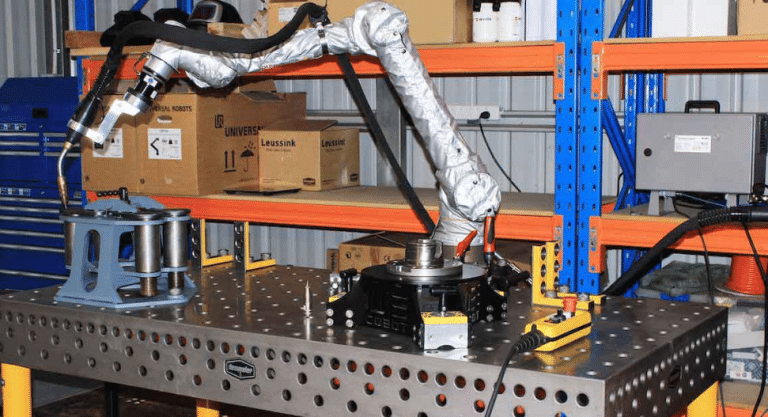
On show at Australian Manufacturing Week was OLP Robotics’ welding arm mounted on a Demmeler 3D table system.
The Demmeler 3D workbench and welding table is a versatile jig and fixturing system for all types of welding and fabrication work. A cobot can be anchored and fixed to a Demmeler table system to ensure accuracy and versatility. The cobot can return to the same position every single time.
Working in partnership with OLP Robotics and other robotic experts, Leussink develops cobot-based systems for clients in a range of industries, enabling them to meet many different requirements.
On show at the University of Wollongong
The University of Wollongong (UOW) has an industry hub at its Shoalhaven campus in Nowra which features Industry 4.0 technology. The new Industry 4.0 hub includes a working demonstration unit of the Demmeler 3D table system with a cobot (collaborative robot).
In the UOW Industry 4.0 Hub, the cobot is set up on a Demmeler table system to undertake welding tasks. The Demmeler system plays a dual role. It holds the cobot firmly and accurately in place, and it also holds the workpiece securely and precisely while the welding is taking place.
“One of the key advantages which we can demonstrate is how quickly it can be set up and programmed for just a few welds, before moving on to the next. Operators do not have to be experts in computer programming or welding to be able to operate the Demmeler cobot system,” said UOW Research Engineer Evan Brown.
How Leussink Supports Your Industry 4.0 Transition
At Leussink, the relationship doesn’t end when we install a system. For us, it’s just the beginning.
We have over 40 years of engineering experience and work across welding and fabrication, precision metrology, mechanical design, and bespoke manufacturing. That breadth matters in an Industry 4.0 context because most real deployments require more than a single technology. They require a partner who can integrate systems, diagnose problems, and stay involved once the equipment is running.
Our welding and fabrication solutions – including the Demmeler 3D table system – integrate directly with cobot platforms to deliver accurate, repeatable results across a wide range of fabrication tasks. Our metrology services use Tomelleri portable metrology arms to bring real-time dimensional data into your production workflow. And through reverse engineering and mechanical design services, we help clients build precise digital records of components and processes – a foundational step for facilities moving toward digital twins or IIoT monitoring.
We work closely with all our clients to make sure your system is performing for your business. We’ll support you through the life of your equipment – from installation and training through to ongoing guidance and access to our full range of accessories.
For more information on our welding and fabrication solutions, send us an enquiry or call us on 02 4260 7777.
What is the difference between Industry 4.0 and Industry 5.0?
When did Industry 4.0 start in Australia?
Is Industry 4.0 relevant for small and mid-sized Australian manufacturers?
Other News
Small Parts Machining: Why Leussink Takes On the Small Jobs Too
Written by Stuart Ward, Sales and Marketing Manager at Leussink...
Written by Stuart Ward,...
Leussink Joins Omega Sinto Foundry Machinery at AFI 2026
Leussink will be at AFI 2026, the Australian Foundry Institute's...
Leussink will be at...
In-House vs Outsourced CNC Machining
In-House vs Outsourced CNC Machining: How to Make the Right...
In-House vs Outsourced CNC...
Casting CNC Machining
Why Casting CNC Machining Is Essential for Australian Foundries Precision...
Why Casting CNC Machining...
Why End-to-End Engineering Wins for Industrial Facilities
End-to-end engineering means working with one engineering partner across every...
End-to-end engineering means working...
CNC Machining vs Manual Machining for Heavy Industry: When Each Method Wins
Quick Answer: CNC machining vs manual machining is a project-by-project...
Quick Answer: CNC machining...
Emergency CNC Machining: What Actually Happens When Critical Equipment Fails?
It’s 2am. A bearing on the main drive has failed,...
It’s 2am. A bearing...
7 Australian Foundry Production Problems (And How Engineering Support Solves Them)
Most Australian foundries don't lose performance overnight. They lose it...
Most Australian foundries don't...
What Makes CNC Machining Essential for Heavy Industry Applications in Australia?
When a critical component fails in a mining operation or...
When a critical component...
How Does Large-Scale CNC Machining Handle Complex Component Production?
Large-scale CNC machining is not simply conventional CNC applied to...
Large-scale CNC machining is...